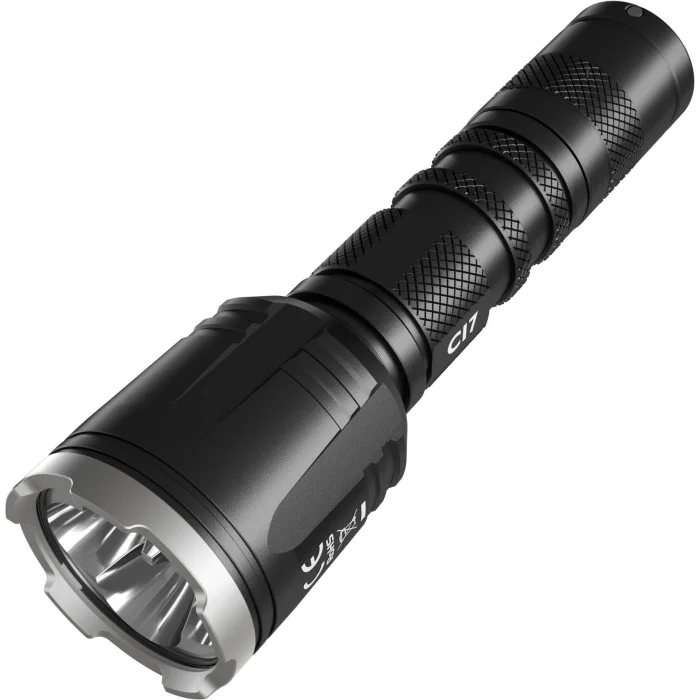

Nitecore Ci7 flashlight + infrared illuminator
189.00 CHF *

Infrared flashlights emit light in the IR range (typically 850 or 940 nm) that is invisible to the human eye but fully usable for night vision devices and IR-sensitive cameras. Used for night observation, wildlife camera support, security surveillance and in hunting.
Infrared light lies in the wavelength range above the visible spectrum (700 nm and higher). The human eye cannot or only weakly perceive it. 850 nm creates a slight red glow directly at the LED but is standard for surveillance and wildlife cameras. 940 nm is completely invisible but has about 50 % lower efficiency and costs more – ideal for covert observation. Night vision devices and IR cameras amplify the reflected IR light and create a visible image – without IR emitter they only have natural residual-light amplification.
Different use cases have different requirements:
Most important: wavelength matched to application. For mainly technical applications (wildlife camera supplement, security camera) 850 nm is enough. For completely covert observation with night vision, 940 nm is mandatory. Check range (typically 200-1'000 m depending on output in mW). The spot characteristic also matters: a tight spot reaches further, a wide one illuminates a larger field of view. Some models offer dual-mode (IR + visible light) – practical when the lamp is to be both night vision supplement and normal flashlight. Make sure the IR emitter does not thermally throttle in long operation – IR LEDs generate more heat than visible LEDs.
850 nm shows a weak red glow at the LED – disturbing for covert observation, otherwise mostly acceptable. 940 nm is completely invisible but has about half the range and costs more.
At 850 nm you see the LED itself glow slightly red, but not the light in the room. At 940 nm even the LED is completely invisible. Smartphone cameras pick up IR light partially – a test trick: briefly look at the LED with the smartphone camera.
Depends on power and optics. Standard models (1-3 W) reach 100-300 m, high-power IR emitters (5-15 W) up to 1'000 m or more – combined with good night vision devices.
With direct exposure over long periods high-power IR light can lead to eye damage – without you noticing because the eye does not react (no blink reflex). Avoid looking directly at the beam, IR protective glasses for professional use are advisable.
Original goods from Swiss stock · Free shipping over CHF 100 · Personal advice
| id | title | price | manufacturer |
|
from *
/ |