Free shipping from CHF 100
Quality for over 20 years
Personal consultation

Fixed blade knives with Scandi grind for woodwork, feathersticks, tinder and campfire – from the premium full-tang classic Morakniv Garberg through the BeaverCraft BSH series in European high-carbon steel to the Swedish carbon classic Hultafors. Freely available in Switzerland, stocked in Menzingen with personal advice.
Bushcraft is the art of finding your way in the woods with minimal gear – preparing tinder, carving a featherstick, lighting a campfire, building a shelter, crafting tools from wood. The term originates in the Australian and North American outdoor tradition and established itself in Europe via the Scandinavian school (Mörs Larsson, Lars Fält). The bushcraft knife is the central tool: fixed blade, Scandi grind, medium blade length, robust build. Not too small for splitting, not too big for fine carving.
Classic fields of use: woodwork (feathersticks from pine or birch, whittling, spoon and cup blanks), tinder preparation (fire material from birch bark, fatwood, hay), batoning (splitting wood with the help of a baton), campfire preparation and general outdoor tasks. For pure woodcarving and detailed work, dedicated carving tools are the more precise choice. For large wood and dense growth, an axe or a machete is the better partner. The bushcraft knife is the robust all-rounder in between.
A bushcraft knife is the specialist among fixed blade knives: more precise on wood than a hunting knife, more robust than a carving knife, more compact than a survival knife. Ideal for everyone working or overnighting in the woods and needing a reliable tool that doesn’t fail even after several hundred feathersticks and batoning runs.
If you need a robust all-round outdoor knife with a drop-point blade that’s also survival-capable, look at the outdoor and survival knives. For big game and stalking, hunting knives with a clip point are more suitable. For pocket-friendly EDC carry, take a folding knife or one-handed knife. The bushcraft knife is the dedicated forest specialist with Scandi grind and carbon or stainless blade in the 9–11-cm length.
The tang construction (the blade extension running into the handle) determines load capacity, the blade shape determines typical application. For bushcraft, two tang constructions are common:
For bushcraft beginners and everyone who regularly practises batoning, we recommend Full Tang – the additional stability is decisive in an emergency. Hidden Tang remains the traditional lightweight classic for hiking tours with reduced weight.
| Blade shape | Characteristic | In bushcraft |
|---|---|---|
| Drop Point | Gently descending blade spine, robust tip | All-purpose, featherstick, whittling (Morakniv Garberg) |
| Spearpoint | Symmetrically tapering, central tip | Precision and piercing, Mora 2000 |
| Bushcraft blade | Classic drop-point shape with Scandi grind | Woodwork, tinder, featherstick (BeaverCraft BSH) |
| Clip Point | Curved blade spine, fine tapered tip | More hunting, less bushcraft |
| Scandinavian shape | Tall blade with straight spine line | Traditional Sloyd and bushcraft classic |
For bushcraft, Drop Point and the classic bushcraft blade are first choice – they offer stability at the tip and enough belly for fine cuts. Spearpoint is the symmetrical variant for stalking and general outdoor tasks.
For bushcraft knives, the steel determines three properties: edge retention (how long does the blade stay sharp), corrosion resistance (how critical is moisture) and field sharpenability (with a simple stone). Our range covers the most important bushcraft classes:
| Steel | Hardness (HRC) | Properties | In our range |
|---|---|---|---|
| Carbon «C» (Sandvik) | ~58–62 | Very sharp, easy to sharpen, rust-prone – develops patina | Morakniv Garberg BlackBlade C, Mora 2000 C |
| 1066 / 65G (high-carbon) | ~57–62 | European high-carbon, precision-ground with Scandi bevel | BeaverCraft BSH series |
| Stainless 14C28N (Sandvik) | ~57–60 | Rust-resistant, balanced, low maintenance | Morakniv Garberg S |
| Hultafors Carbon | ~58–60 | Swedish classic carbon, traditional design | Hultafors OK1, OK4 |
| Laminated Carbon «LC» | ~58–62 (core) | Sandwich of hard core and soft jacket, Sloyd tradition | Morakniv LC models |
Pure carbon steel is the traditional bushcraft choice – it takes the finest edge and can be touched up in the woods with a simple water stone or a flat field stone. Downside: carbon rusts without care, but builds up a dark patina over time that provides additional surface protection. Stainless is the low-maintenance compromise for damp conditions and multi-day tours without intensive care. For beginners we often recommend the stainless variant of the Garberg, for traditionalists the carbon versions.
Five factors decide which bushcraft knife fits your use:
For a complete overview of all knives, see the main category Knives & Tools; related filters under fixed blade, hunting knives and outdoor and survival knives.
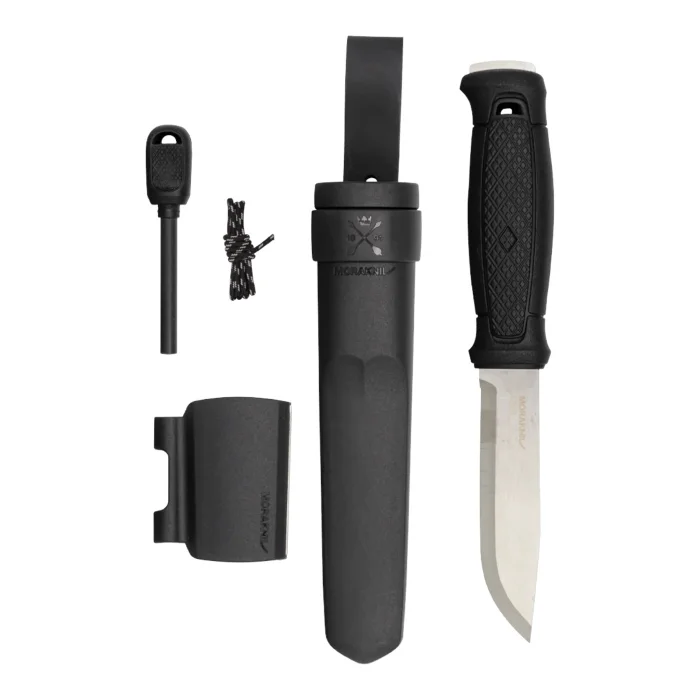
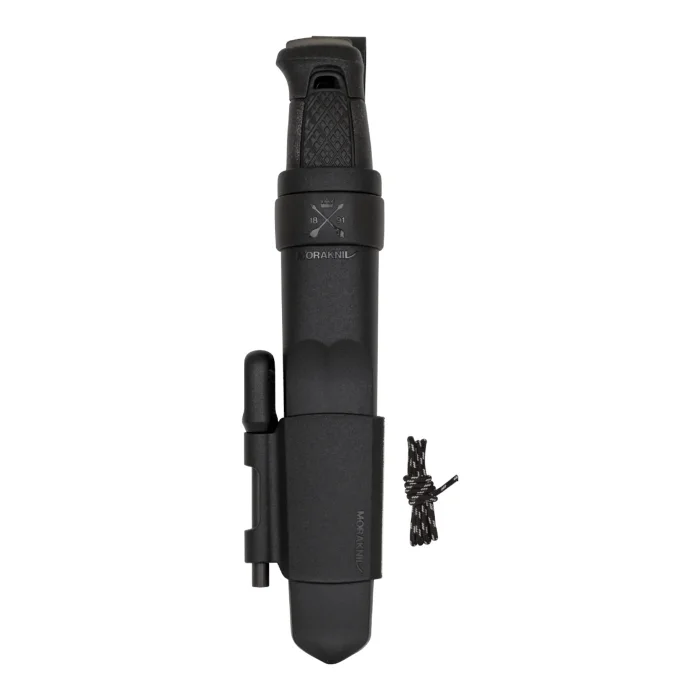
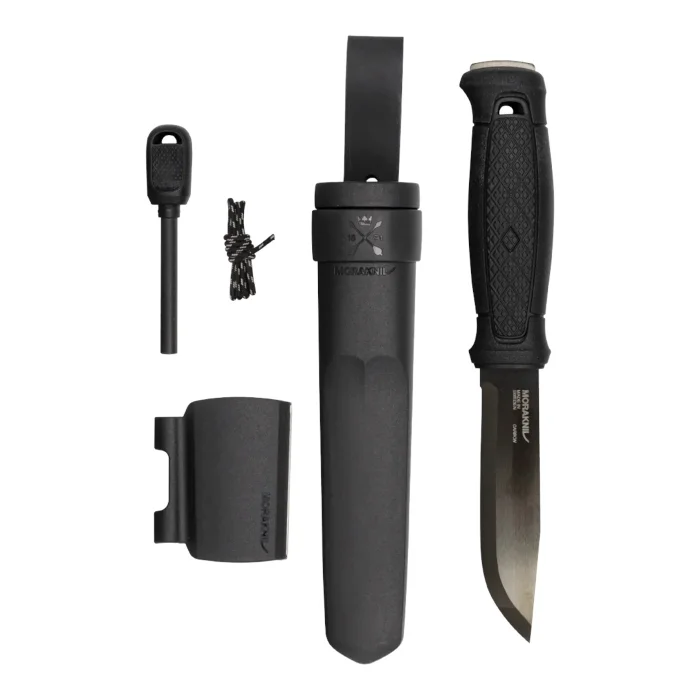
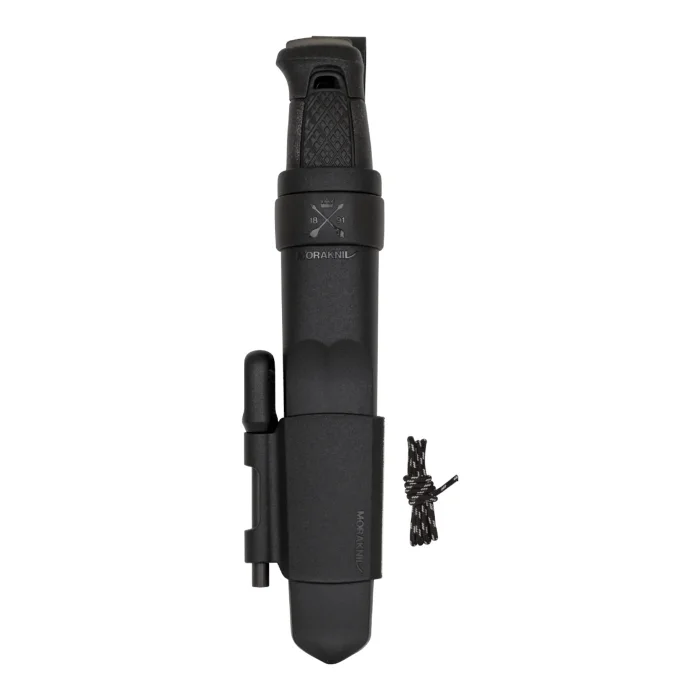
Morakniv (Mora, Sweden, founded 1891) is the reference for the Nordic bushcraft knife and standard equipment in many Swedish workshops and outdoor backpacks. Two focal points in the bushcraft range: first, the Garberg as a full-tang premium classic – available in Stainless (Garberg S Survival Kit, 14C28N Sandvik) and in BlackBlade Carbon with DLC coating. Second, the Mora 2000 series as a compact, light outdoor all-rounder in green (stalking) and orange (driven hunt, mushroom collection). Characteristic: precise Scandi grind, Sandvik steels (Carbon, Laminated, Stainless), outstanding price-to-performance ratio.
BeaverCraft (Lviv, Ukraine, founded 2014) is the specialised bushcraft brand in our range. The BSH series (BSH1, BSH2, BSH3, BSH4 and BSH5 Shadow) is consistently designed as a full-tang bushcraft knife with Scandi grind, plus the BSH KID bushcraft knife for children with a rounded blade tip. The blades are made from European high-carbon steel (1066 or 65G), heat-treated to 57–62 HRC and precision-ground with Scandi bevel and 20-degree blade angle. Important: the blades are laser-cut from EU sheet steel and press-formed, not freehand-forged – the industrial process ensures consistent quality and a fair price-to-performance ratio. Only the BeaverCraft bushcraft axes (AX1, AX6) are actually hand-forged.
Hultafors (Hultafors, Sweden, since 1883) is one of the most traditional Swedish tool manufacturers and represented in our bushcraft range with the OK1 and OK4 outdoor knives in carbon steel. Characteristic: solid, no-nonsense Swedish design, excellent price-to-performance ratio and the typical Swedish carbon-steel grind. Ideal for bushcraft beginners and everyone looking for a robust woodworking knife at a small price. Blade lengths just below the full-tang level, traditional hidden-tang build.
Three characteristics: First, the Scandi grind, a blade geometry with a single flat grinding angle (about 20 degrees per side) without a secondary bevel – ideal for precise woodwork. Second, the medium blade length of 9 to 11 cm – big enough for batoning, small enough for fine featherstick carving. Third, the robust tang construction, mostly Full Tang, for intensive woodwork and occasional prying. A normal outdoor or survival knife often has a hollow grind or flat grind with a secondary bevel, is usually larger (12–15 cm) and designed for all-purpose tasks instead of woodwork.
Yes. Fixed-blade bushcraft knives are freely available and may be carried without special restrictions under Article 4 of the Swiss Weapons Act. You don’t need a justified reason to carry a bushcraft knife. Prohibited, however, are butterfly/balisong knives, gravity knives, switchblades with blades over 5 cm and throwing knives – but those are all special types and not bushcraft knives. Source: fedpol.admin.ch.
For bushcraft we recommend Full Tang. Full Tang means the blade extends at full width and length to the end of the handle with handle scales riveted or screwed on both sides – this makes the knife practically indestructible under lateral load, prying and batoning. You can recognise Full Tang because a thin blade strip is visible at the top and bottom of the handle. Examples: Morakniv Garberg, BeaverCraft BSH series. Hidden Tang is the more traditional lightweight variant – more ergonomic and lighter, but slightly less load-capable. A valid alternative for hiking tours with reduced weight.
The Scandi grind (also Scandi bevel) is the typical Nordic blade geometry: a single flat grinding angle of about 20 degrees per side from the spine to the edge, without a secondary bevel. Advantage: the blade enters wood precisely and in a controlled way – ideal for featherstick, whittling and woodwork. Disadvantage: in all-purpose cutting (packaging, ropes) somewhat less universal than hollow grind or flat grind. Classic on Morakniv and BeaverCraft, hallmark of the Scandinavian bushcraft tradition. When sharpening, the Scandi bevel is laid flat on the stone, which makes the maintenance procedure very simple.
Both have their justification. Carbon steel (Morakniv Garberg BlackBlade C, BeaverCraft BSH series 1066/65G, Hultafors OK1/OK4) is very sharp, can be honed to razor sharpness with a simple stone and cuts wood precisely – but rusts without care and needs regular wiping and light oiling. Stainless (Morakniv Garberg S in 14C28N Sandvik) is rust-resistant and low-maintenance, but slightly less edge-retentive. For pure bushcraft in dry conditions, carbon is first choice; for damp environments, multi-day tours without intensive care or saltwater contact, stainless is the safer bet.
No, the BeaverCraft bushcraft knives of the BSH series are not hand-forged. The blades are made in an industrial process from European high-carbon steel sheet (1066 or 65G), laser-cut and press-formed, then heat-treated to 57–62 HRC and precision-ground with Scandi bevel and 20-degree blade angle. Final assembly (handles, sheaths) and quality control are done by hand. The industrial process ensures consistent blade quality and a fair price-to-performance ratio. The only BeaverCraft products that are actually hand-forged are the bushcraft axes AX1 and AX6.
The sweet spot lies between 9 and 11 cm blade length. In this range you have enough blade surface for batoning (splitting smaller wood with the help of a baton) and at the same time the necessary control for fine carving (featherstick, spoon blank). Blades under 9 cm like the BeaverCraft BSH KID are more compact and ideal for children, smaller hands or as a secondary knife. Blades over 11 cm target more outdoor and survival use with rougher woodwork. Practically all recommended bushcraft classics (Morakniv Garberg, BeaverCraft BSH1–BSH4) sit exactly in this sweet-spot range.
For carbon-steel blades with Scandi grind (Morakniv Garberg C, BeaverCraft BSH, Hultafors OK1/OK4), a simple water stone with grit 1’000 and 3’000 or a classic natural sharpening stone is enough. Important: lay the Scandi bevel flat on the stone, without a secondary bevel – that produces the typical wood precision. For stainless blades (Garberg S), diamond stones or guided sharpening systems with a fixed angle (Lansky, KME) at 18 to 22 degrees per side are recommended. A leather strop at the end brings razor sharpness. In the woods, a flat field stone or a small diamond file is often enough for touch-ups. More choice of stones in the sharpener filter.
Carbon steel rusts when not kept dry – that’s not a defect, it’s a property. Three points are enough: First, after each use, wipe the blade with a dry cloth; in damp conditions, additionally rub with a hint of Ballistol or gun oil. Second, don’t submerge in dishwater and don’t store wet in the sheath – residual moisture builds up there. Third, after saltwater or blood contact, clean immediately. Over time, carbon steel develops a dark patina – that’s desired and provides additional surface protection. A forced patina (e.g. with apple cider vinegar or mustard) can accelerate this protection.
For getting started we recommend three models: the Morakniv Garberg S Survival Kit (Stainless 14C28N, Full Tang, polymer sheath with MOLLE) as a low-maintenance all-rounder – probably the most-recommended bushcraft entry choice in Europe. The BeaverCraft BSH1 (carbon steel 1066, Scandi grind, leather sheath) as a classic bushcraft knife with a warm wood handle and leather sheath – the pure bushcraft experience. The Hultafors OK1 as a budget-conscious alternative with Swedish carbon tradition. For children or very young bushcraft beginners, the BeaverCraft BSH KID with rounded blade tip is the right choice. Important for all beginners: first practise featherstick and whittling in wood before moving to batoning – blade control matters more than blade size.
Batoning is the splitting of wood with the help of a striking stick (baton): you place the knife on the wood to be split, strike a baton on the blade spine and drive the blade through the wood. With a full-tang bushcraft knife of sufficient blade length (at least 1 cm longer than the wood is thick) this is easily possible and a standard bushcraft technique. With hidden-tang knives, batoning is recommended only with restraint, since the load at the blade-tang junction can be high. For large wood from about 10 cm diameter, we recommend a bushcraft axe or a machete as a complementary tool.
Yes. All bushcraft knives are available from our warehouse in Menzingen (ZG) – no waiting time, no customs fees. Free shipping within Switzerland and Liechtenstein from CHF 100. Personal advice in our showroom or by phone at 041 755 34 33. In case of dissatisfaction, our 30-day voluntary right of return applies.
Original goods stocked in Switzerland · Free shipping from CHF 100 · Personal advice at 041 755 34 33
| id | title | price | manufacturer |
|
from *
/ |